
working memory, and cognitive flexibility
Diamond, Annual Review of Psychology, 2013
groups with ADHD scored lower on executive function
Willcutt et al., Biological Psychiatry, 2005
have current ADHD
NIMH, survey data from 2001 to 2003
ADHD executive dysfunction is difficulty with the mental skills that run your day: deciding what matters, holding it in mind, starting, tracking time, and switching gears. It isn't laziness or not caring, it's how the ADHD brain manages those skills, and the right kind of support can make days easier.
I know what I'm supposed to do today. I have a list, a calendar, and three different apps. It's 2pm, and I'm standing in the kitchen, still unable to tell which thing comes first.
Someone tells me something and I say "got it." Ten minutes later, it's gone. Not misplaced. GONE, as if it was never said. I write everything down, and then I loose the note.
My day disappears in chunks, I look up and it's evening. People tell me how capable I am, and I know they're right, which is exactly what makes it so confusing.
Executive function is your brain's management system. It helps you plan, prioritize, hold information in mind, start tasks, switch between them, and keep track of time. ADHD is widely described as a biologically based, developmental difference in these skills. The skills are there, but they aren't reliably available when you need them.
When everything looks equally urgent, the brain cannot rank it, so nothing becomes the next thing.
Working memory is a small desk. When it fills up, things fall off before you can write them down.
Time and sequence are hard to feel from the inside, so a plan doesn't turn into steps on a clock.
Standard time management advice was designed for brains that can already feel time.
For the ADHD brain, most of it skips the actual problem.
A list hands you the hardest part of the job, which is ranking everything on it. Fifty items in no order is still a pile of decisions.
A planner holds a plan, it doesn't build one, keep it in view, or remind you to open it.
Effort is not the missing piece. The skills that direct effort work differently, so more effort without support can leave you more worn out.
Lumi cannot change how your brain manages itself, but it can be the steady
presence that carries some of the load. Choosing your one thing,
catching what slips, and keeping your day in view.
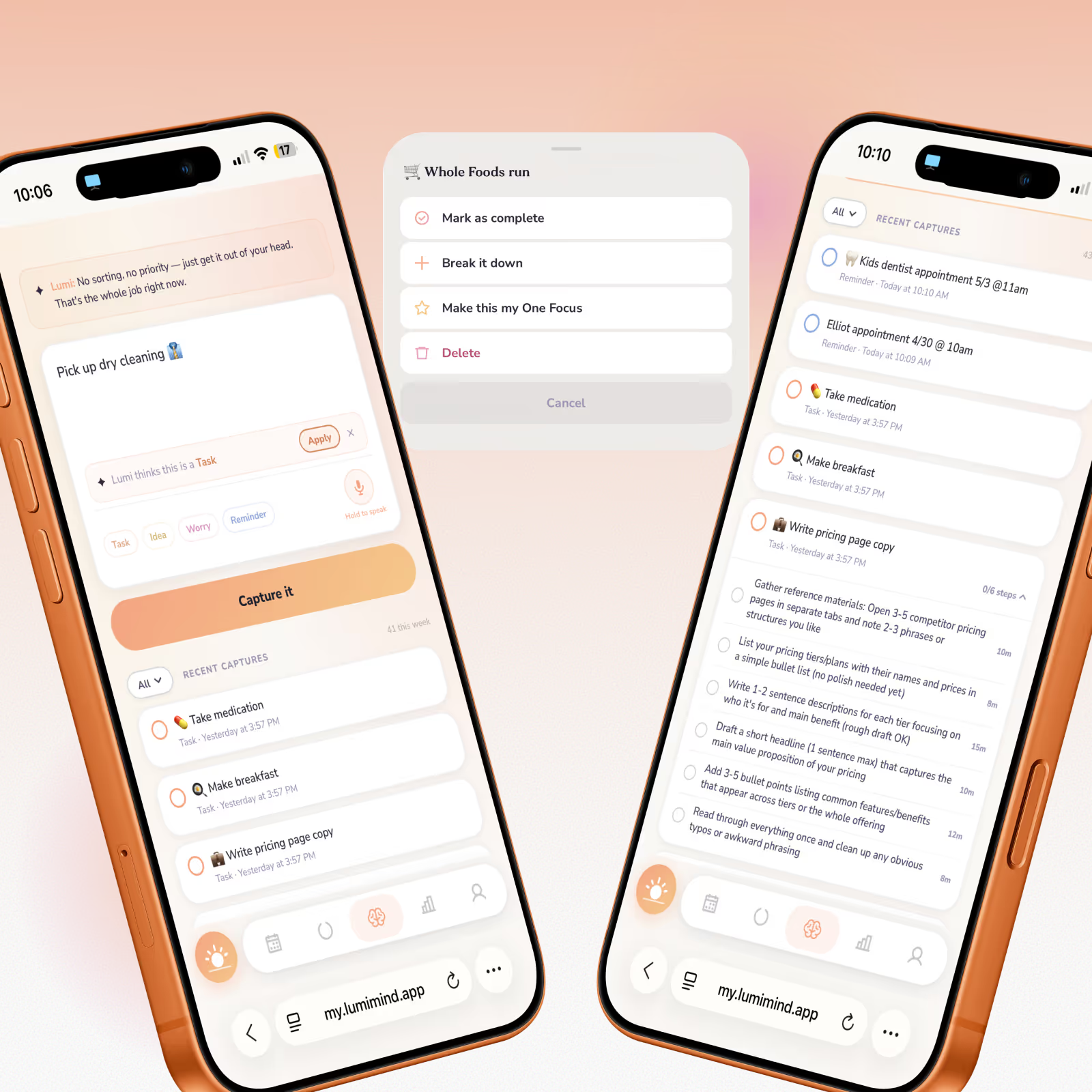
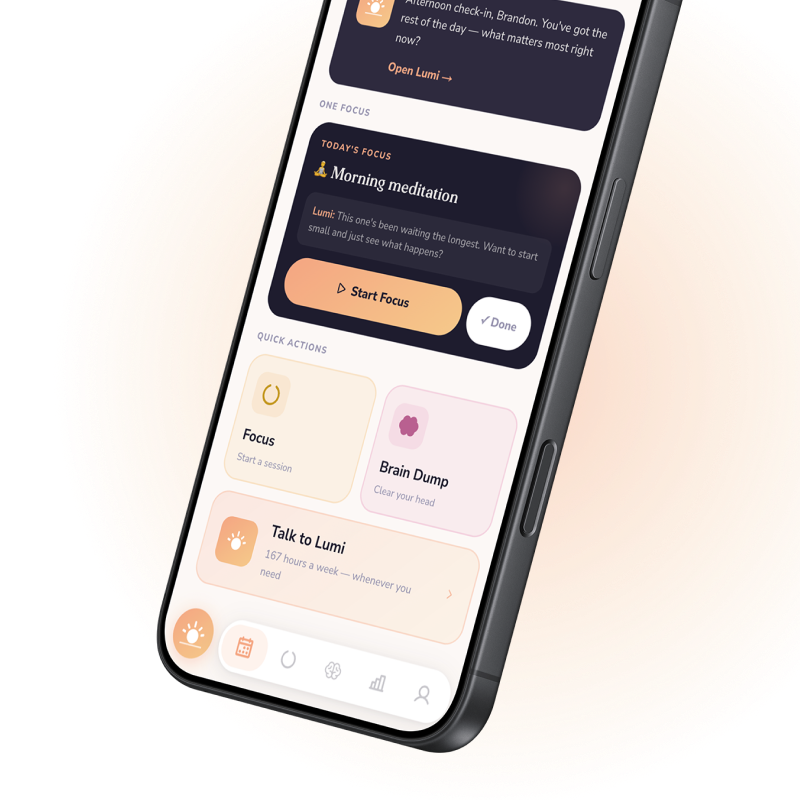
Deciding what to do is where executive dysfunction often hits hardest. One Focus looks at your mood, your week, and what needs to happen today, then shows you your one thing. Everything else stays out of sight until you're ready. It's an invitation, not an order, and Lumi takes on the sorting so you can take on the doing.
Join The Waitlist

Working memory fills fast. Brain Dump gives every task, worry, and half-finished idea somewhere to land. Type it or say it in any order without sorting it first. The sorting happens later, and the relief happens now.
Join The WaitlistTime is hard to feel from the inside. Today lays out your day where you can see it, with gentle warnings before a transition so "soon" doesn't turn into "late". Widgets keep the plan on your home screen, so you don't have to remember to open the app.
Join The Waitlist
Executive Dysfunction doesn't only show up at your desk. Lumi is there for the other moments too.
Lumi is built for all of it
ADHD executive dysfunction is difficulty with the brain's management skills: planning, prioritizing, holding information in mind, starting tasks, switching between them, keeping track of time, and managing emotions. It is a symptom, not a diagnosis on its own, and it has nothing to do with intelligence, effort, or caring about the outcome.
Yes. Executive dysfunction is considered one of the key symptoms of ADHD, and ADHD is widely described as a biologically based, developmental difference in executive function. Not everyone with ADHD is affected in every area, though, and executive dysfunction also appears in other conditions, including autism, depression, and OCD, so having it does not by itself mean you have ADHD.
No. Laziness is a lack of willingness, and executive dysfunction is a difference in the brain's management skills, so the effort is there while the follow-through isn't reliable. Procrastination is a conscious choice to delay something, while executive dysfunction involves brain processes that are not easily controlled. It is not laziness, and it is not simply not caring.
Common signs include trouble deciding where to start, losing track of time, difficulty switching between tasks, struggling to break a big goal into steps, trouble following multi-step directions, and strong emotions that are hard to manage in the moment. From the outside it can look like disorganization or inconsistency. On the inside, it is the effort of running skills that don't switch on reliably.
Executive dysfunction is the broader pattern: difficulty planning, prioritizing, remembering, and managing time. Task paralysis is one way it can show up, the freeze at the moment of starting. You can have executive dysfunction without freezing, and the two often overlap. Our page on ADHD task paralysis covers the starting side in more detail.
In ADHD, executive function differences are considered biologically based and developmental. They are part of how the brain develops, not the result of effort, upbringing, or willpower. Executive dysfunction can also come from other conditions, such as autism, depression, OCD, and brain injury, which is one reason a clinician is the right person to work out what is behind it.
Treatment focuses on the underlying condition. For ADHD, that can include medication, such as stimulants, and therapy such as cognitive behavioral therapy, and clinicians often combine them. Many people also find day-to-day supports useful, like making decisions and reminders external, shrinking the first step, and making time visible. Lumi is a companion, not a treatment, and it doesn't replace care from a clinician.